

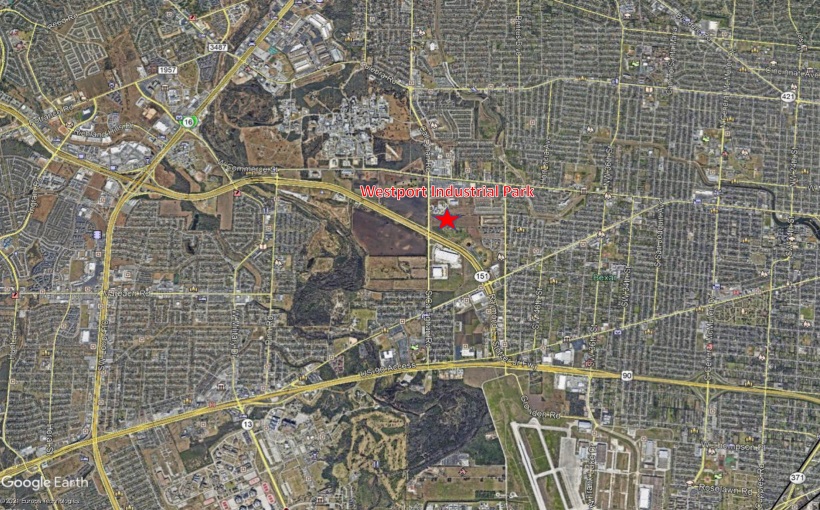
San Antonio-based Koontz Corporation plans to develop Westport Industrial Park, a 35-acre industrial project near the corner of South Callaghan Road and Highway 151 on the Near West side of San Antonio.
San Antonio-based Koontz Corporation plans to develop Westport Industrial Park, a 35-acre industrial project near the corner of South Callaghan Road and Highway 151 on the Near West side of San Antonio.

Koontz Set to Develop 35-Acre Industrial Park on the Near West Side of San Antonio

The residential project will be in close vicinity to the Fiesta Trails shopping center.
Koontz Corporation’s New 300-Unit Multi-Family Apartment Community Will Add More Walkability to San Antonio’s Northwest Sector

Businesses will need new mechanisms to verify that agents act legitimately on behalf of authorized users, and to ensure accountability when autonomous systems make mistakes. McKinsey also points to the emergence of an “agentic AI mesh,” a software architecture designed to coordinate agent memory, orchestration, traceability, and governance at scale. These systems enable communication and data sharing across multiple agents and platforms. From a technical standpoint, this transformation depends on a new class of integration standards and protocols.
“Powered by Worldline’s platform, this transaction proves that we are fully enabled across acceptance, acquiring, authentication and issuer processing at a pan-European level. This ensures that ING retains supreme control over authentication logic, allowing the entire payment path to be completely traceable, audited, and secured across the full settlement chain. Run over the Mastercard network, the real-world transaction https://legaleaglefirm.uk/meta-and-amazon-settle-uk-antitrust-probes-over-use-of-third-party-data-to-benef was completed between an ING cardholder and a merchant based in the Netherlands.
Across all channels, the merchant remains the merchant of record. Products are syndicated across every major AI channel automatically—with no apps to install, no custom integrations, and no transaction fees beyond standard processing rates. With Catalog, a merchant lists once and is automatically syndicated to every current and future AI partner—including ChatGPT, Microsoft Copilot, and the Shop App. Any updates made in admin—new pricing, inventory changes, updated descriptions—are reflected automatically across all AI channels.
For example, a shopper may ask an AI agent to restock household essentials within a specific budget and delivery timeframe. Early pilots show that AI assistants can help consumers discover products, compare options, and, increasingly, make purchases on their behalf. Try Shopify for free, and explore all the tools you need to start, run, and grow your business.
Agentic commerce, like eCommerce and mobile before it, is a generative growth opportunity — not a zero‑sum shift. The pace of agentic commerce adoption remains uncertain, but payment infrastructure decisions are being made today. These priorities suggest that competitive differentiation in agentic commerce may be shaped as much by trust infrastructure as by payment infrastructure. As autonomous commerce evolves, merchants will increasingly look to their payments partners to help establish the trust frameworks that govern how AI agents transact.
Overall, Universal Commerce Protocol gives builders the tools they need to create new shopping experiences. What’s new in Spring ’26 is that any developer can access millions of Shopify merchants using Shopify’s tools. Building https://consultprofound.com/telkomcel-holds-tais-2025-strengthens-commitment-to-innovation-and-digital-transformation.html?noamp=mobile on Shopify’s agentic commerce layer used to require approval. The agentic commerce infrastructure is now self-serve for every developer. Anyone can now build end-to-end agentic commerce on Shopify, and the platform underneath every app gets a foundational rebuild.

Through its scale and investments in R&D—particularly artificial intelligence and stablecoins—Stripe accelerates the utility of frontier technology in the global economy. Stripe users include half of the Fortune 100, 80% of the Forbes Cloud 100 and 78% of the Forbes AI 50. Customers should make their purchase decisions based upon features that are currently available. These advancements ensure businesses can deliver seamless, AI-powered commerce experiences at the forefront of the industry. The partnership between Salesforce and Stripe to integrate with the Agentic Commerce Protocol marks a transformative moment for the future of shopping. “We’re excited to partner with Salesforce to help merchants using Agentforce Commerce thrive in the agentic commerce era.
We are actively working with agents, networks, and other industry participants as standards continue to evolve. Common frameworks, developed by industry bodies, networks, or standards organizations, will help ensure agents can interact consistently with checkout and payment systems. Like earlier phases of digital commerce, it will require trust by consumers, clear value for merchants, and transparency for ecosystem participants, including payment providers. Agent-embedded commerce will take time to scale–and autonomous shopping, where agents complete purchases without human approval, will take even longer. Many of the current iterations of ‘agentic commerce’ are not actually autonomous–meaning agents are just another form of embedded shopping, similar to social commerce. Now, protocols are emerging to establish direct integrations between agents and merchants.

AI agents can help consumers reduce search time and speed up decision-making by delivering personalized product recommendations based on purchasing history and preferences. In recent years, major e-commerce platforms and payment providers have expanded API capabilities to support automated purchasing workflows and subscription management. Increasingly, this integration is discussed in terms of emerging or proposed standards—often referred to as an Agentic Commerce Protocol (ACP). These interfaces enable merchant-to-agent communication so that AI agents can validate inventory and execute purchases on a user’s behalf. As agentic capabilities evolve, these processes are increasingly multimodal, meaning they incorporate text, images, user history and structured data.
Both Google and OpenAI have built platforms for agent-enabled transactions, with companies like Stripe and Uber signed on as partners. “New agentic shopping tools will allow people to find just the right set of products from the businesses in our catalog.” We’ve guided merchants through major shifts before, and we’re ready to help them succeed in the era of agentic commerce.